Everything You Need To Know About Tactical Readiness Training
What is AEDA?
AEDA (Avoid Escape Defend Academy) develops men and women who are AEDA Ready — responding lawfully and leading prudently when confronted with imminent threats and danger.
What are my official credentials as a Firearms Instructor?
Al Tucker is the Founder and Lead Instructor of Avoid Escape Defend Academy (AEDA), where responsible citizens learn to think clearly, act lawfully, and protect what matters most.
Credentials
United States Concealed Carry Association (USCCA)
Instructor # 3938142
Avoid Escape Defend ACADEMY, LLC
Certified with the USCCA since 11/1/2025
Certifications
- Concealed Carry & Home Defense
- Countering the Mass Shooter
- Emergency & First Aid
- Women’s Handgun and Self-Defense Fundamentals
- Range Safety Officer
Training Philosophy
My instruction goes beyond marksmanship.
Every class is designed to develop sound judgment, disciplined decision-making and the confidence to respond appropriately under pressure.
Students leave with more than technical skills — they gain a practical framework for becoming prepared, principled protectors at home, in public and within their communities.
Every AEDA course is built upon four guiding principles:
- Be Prudent — Think First. Think Completely.
- Be Proficient — Master your entire protective toolbox through repetition and review.
- Be Protective — Be READY so you don’t have to get ready.
- Be Parliamentary — Honor the law in a way that protects your freedom.
“We don’t simply train people to carry firearms. We train diligently and specifically to become prepared, principled human beings.”
— Al Tucker, Founder & Lead Instructor, AEDA
What Virtual Training do we offer?
We offer virtual Basic Firearms training for men and women.
M-TAC: Masculine Tactical Training (Virtual)
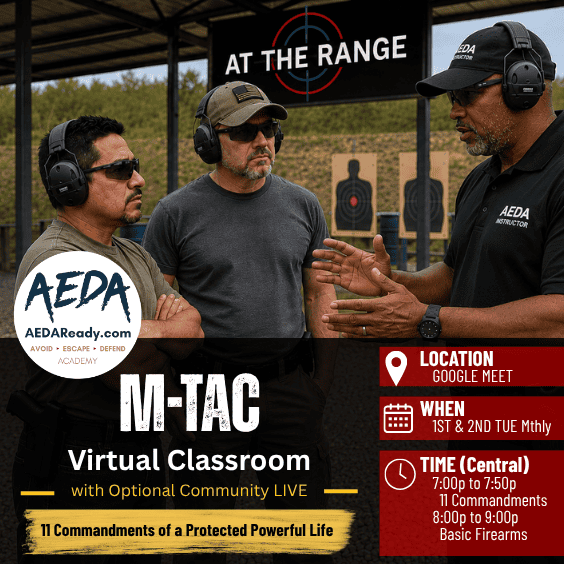
2 Hours Classroom ONLY (Virtual) – NO Range Live Fire
Virtual training is conducted through Google Meet.
- The 11 Commandments Of A Protected Powerful Life — For Men (1st Hour)
- Standard Firearms Curriculum (2nd Hour)
- 1ST or 2ND Tuesday 7:00pm to 9:00pm (Virtual Training)
Investment: $99
Note: The Basic Firearms Virtual Course provides the required classroom curriculum before Range Live Fire is facilitated.
S.A.S.S.Y. One: Basic Firearms Training for Women (Virtual)
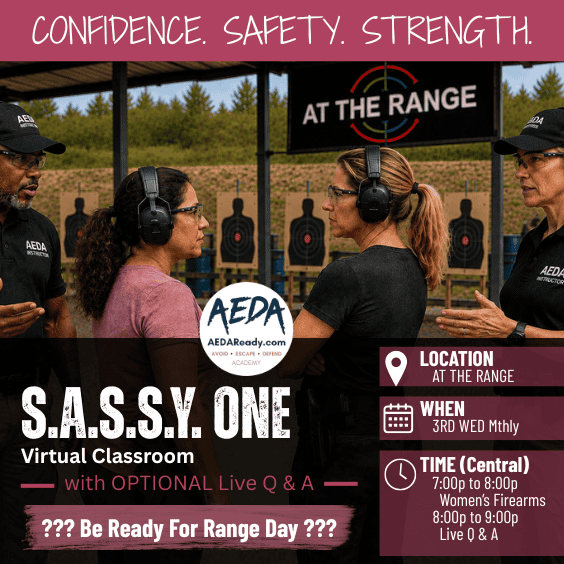
2 Hours Classroom ONLY (Virtual) – NO Range Live Fire
Virtual training is conducted through Google Meet.
- Standard Women’s Firearms Curriculum (1st Hour)
- Optional – Live Q & A: Ask Your Questions and Be Ready For Range Day (2nd Hour)
- 3RD Wednesday of the month 7:00pm to 9:00pm
This includes Basic Firearms Virtual Course + Situational Awareness Curriculum Created for Women.
Investment: $99
Note: The S.A.S.S.Y. One Virtual Course provides the required classroom curriculum before Range Live Fire is facilitated.
What Classroom and Range Live Fire Training do we offer?
We offer Basic Firearms training for men and women (with Virtual Training plus Live Range Fire).
M-TAC: Masculine Tactical Training
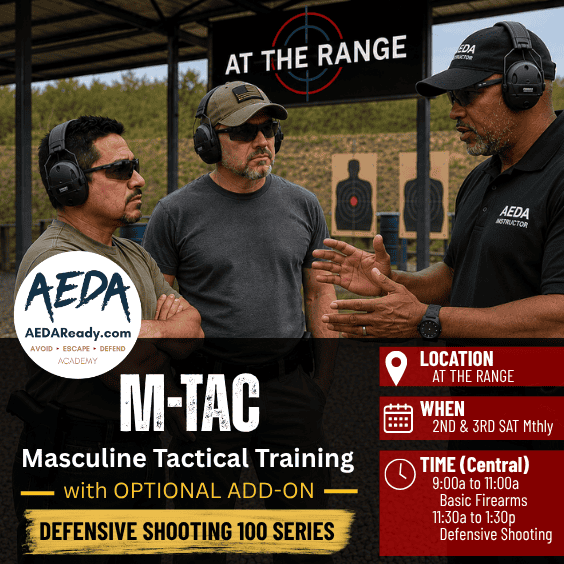
2 Hours Classroom (Virtual)
- The 11 Commandments Of A Protected Powerful Life — For Men (1st Hour)
- Standard Firearms Curriculum (2nd Hour)
- 1ST or 2ND Tuesday 7:00pm to 9:00pm (Virtual Training)
2 Hours Range Live Fire
- 2ND or 3RD Saturday of the month 9:00am to 11:00am
- Choose your SATURDAY after Registration
Investment: $149
Full Package: Virtual Classroom + Range Live Fire + Defensive Shooting 100 Series
- 2ND or 3RD Saturday of the month 9:00am to 1:30pm
- Choose your SATURDAY after Registration
Investment: $249 (For Basic Firearms + Defensive Shooting)
S.A.S.S.Y. One: Basic Firearms Training for Women
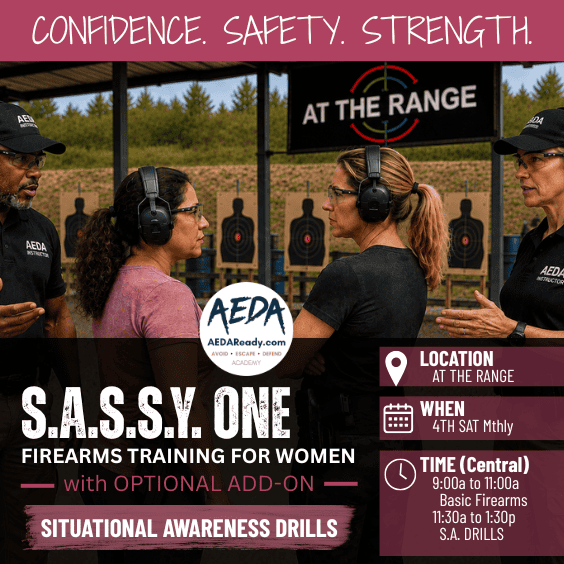
2 Hours Classroom (Virtual)
- Standard Women’s Firearms Curriculum (1st Hour)
- Live Q & A: Ask Your Questions and Be Ready For Range Day (2nd Hour)
- 3RD Wednesday of the month 7:00pm to 9:00pm
2 Hours Range Live Fire
- Range Live Fire on (4th SAT) 9:00 to 11:00am
- Optional: Situational Awareness Drills on (4th SAT) 11:30 to 1:30pm
Investment: $149
PROTECT What Matters (Beginner-Friendly For Men and Women)
Visit this link for details.
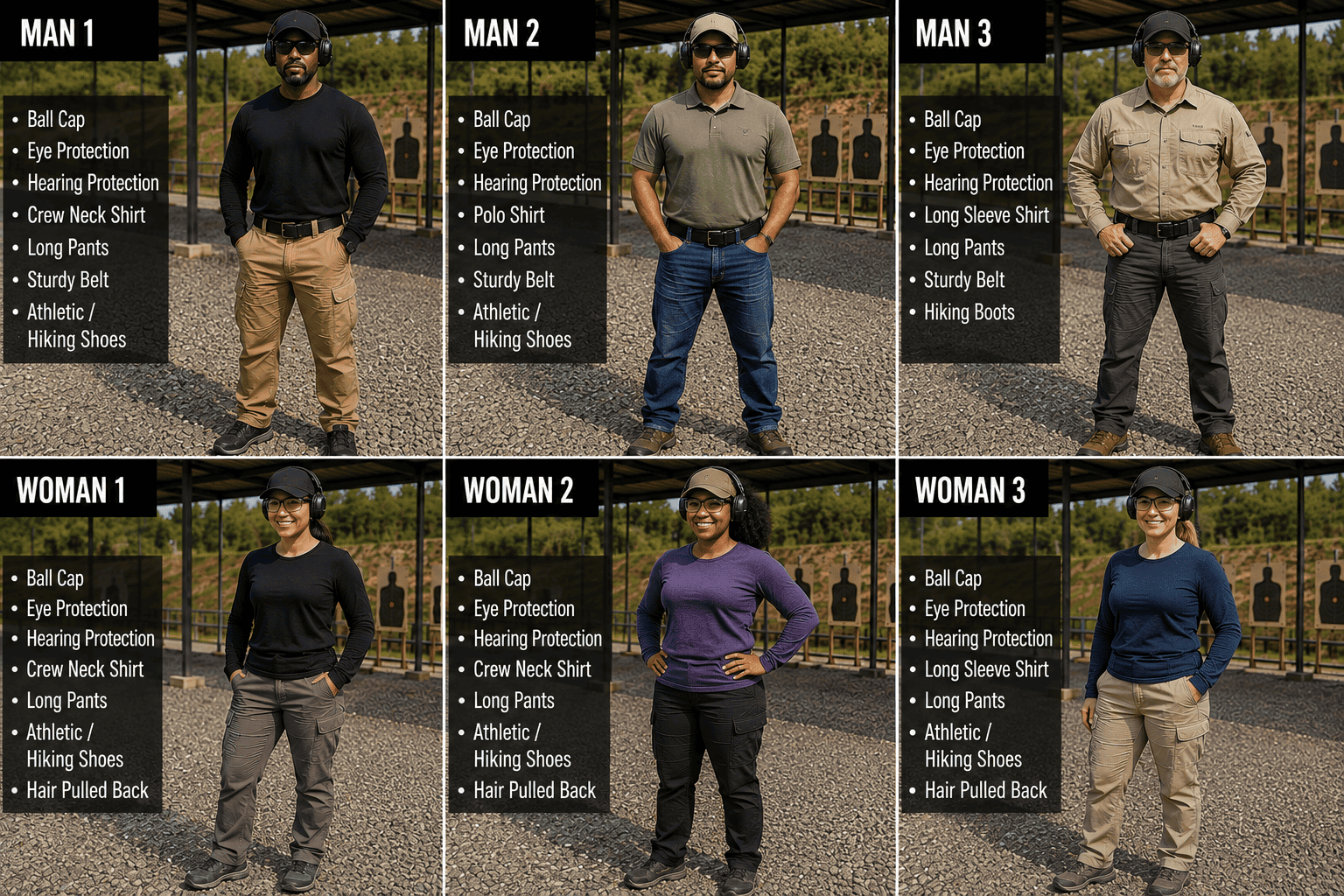
What To Wear On Range Day
Your clothing should allow you to move safely, comfortably and confidently throughout the training day. Since all AEDA range training is conducted outdoors, plan for weather, movement and hot brass.
Visual Examples
For Everyone
✅ Eye Protection (Required)
Protects your eyes from debris, ejected brass and other range hazards.
✅ Hearing Protection (Required)
Electronic hearing protection is recommended so you can clearly hear range commands while protecting your hearing.
✅ Closed-Toe Shoes (Required)
Wear sturdy athletic or hiking shoes with good traction.
Avoid:
- Sandals
- Flip-flops
- Open-toe shoes
- High heels
✅ Long Pants (Strongly Recommended)
Long pants help protect against:
- Hot brass
- Gravel
- Dirt
- Scratches
- Kneeling during drills
Jeans or durable outdoor pants work well.
✅ Comfortable Shirt
- Choose clothing that allows unrestricted movement.
- A higher neckline is recommended to help prevent hot brass from entering your shirt.
✅ Weather Appropriate Clothing
- Outdoor ranges can become hot, cold, windy or wet.
- Dress in layers when appropriate.
- Bring rain gear if conditions require it.
For Men
Recommended:
- Ball cap (helps deflect hot brass and reduce sun exposure)
- Crew-neck T-shirt or polo
- Long pants
- Sturdy belt (especially if wearing a holster)
- Comfortable shoes or boots
Optional:
- Lightweight long sleeves for additional sun protection
Avoid:
- Tank tops
- Open footwear
- Extremely loose clothing that could interfere with equipment
For Women
Recommended:
- Hair secured in a ponytail, braid or bun so it doesn’t obstruct vision or become caught in hearing protection.
- Crew-neck or higher neckline shirt to reduce the chance of hot brass entering clothing.
- Long pants or outdoor training pants that allow comfortable movement.
- Comfortable athletic or hiking shoes.
- Ball cap (recommended for sun protection and to help redirect hot brass).
Optional:
- Lightweight long sleeves for additional protection from sun and brass.
Avoid:
- Low-cut necklines
- Open-toe shoes
- Flowing scarves or loose accessories
- Excessively loose sleeves that may interfere with equipment
During Training
Depending on the class, students may:
- Walk on uneven gravel
- Stand for extended periods
- Kneel during drills
- Move between shooting positions
- Work in warm or cool weather
Dress for movement rather than appearance.
A Few Helpful Items To Bring
- Water bottle
- Sunscreen
- Bug spray (seasonal)
- Small towel (summer months)
- Light jacket or rain layer (when needed)
- Notebook and pen
Our Goal
We want you focused on learning—not distracted by uncomfortable clothing, changing weather or preventable safety issues.
Prepare before it matters.
What 1-on-1 Tactical Coaching do we offer?
We offer tactical coaching for your needs on and off the firing range.
TAC-Ready Gear
Tailored Recommendations Based On Your Needs
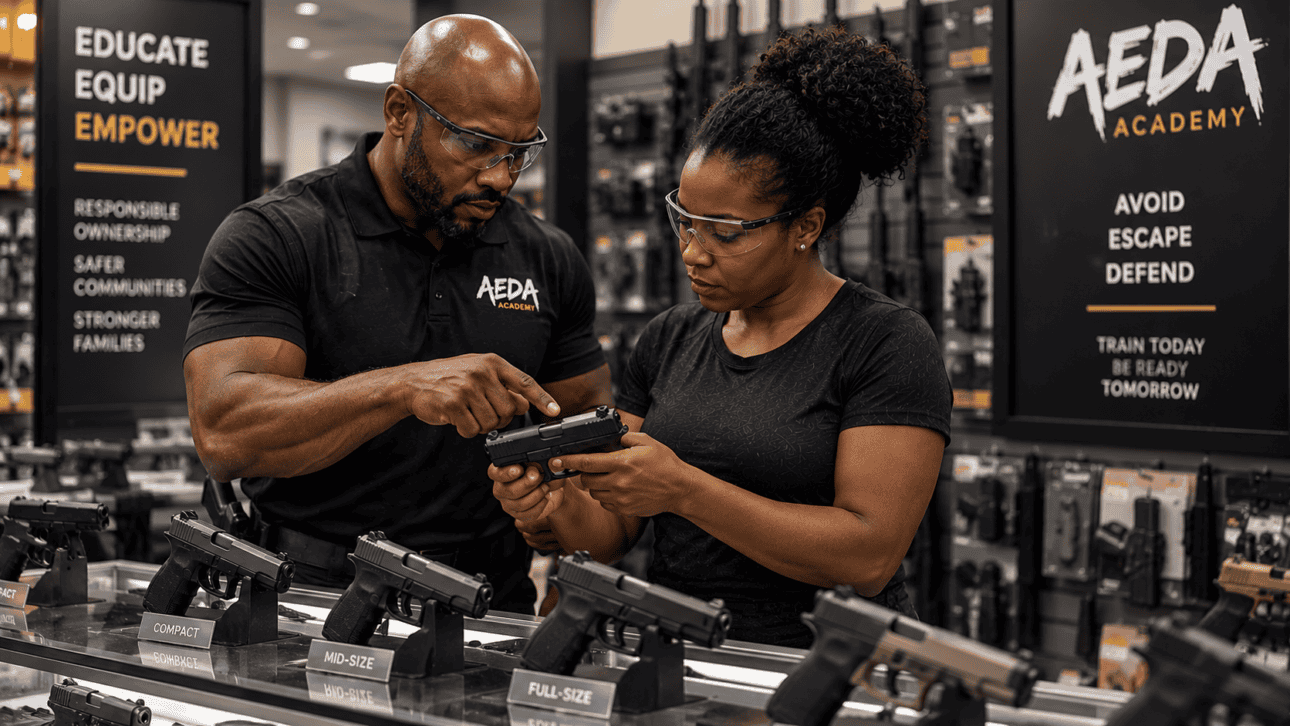
No Range LIVE Fire
Investment: $75/hour
Ideal for:
- Firearm selection
- Readiness planning
- Gear questions
- Confidence development
- Dry-fire coaching
TAC-Ready Range
Tailored Live Range Fire Feedback
Includes Range LIVE Fire
Investment: $150
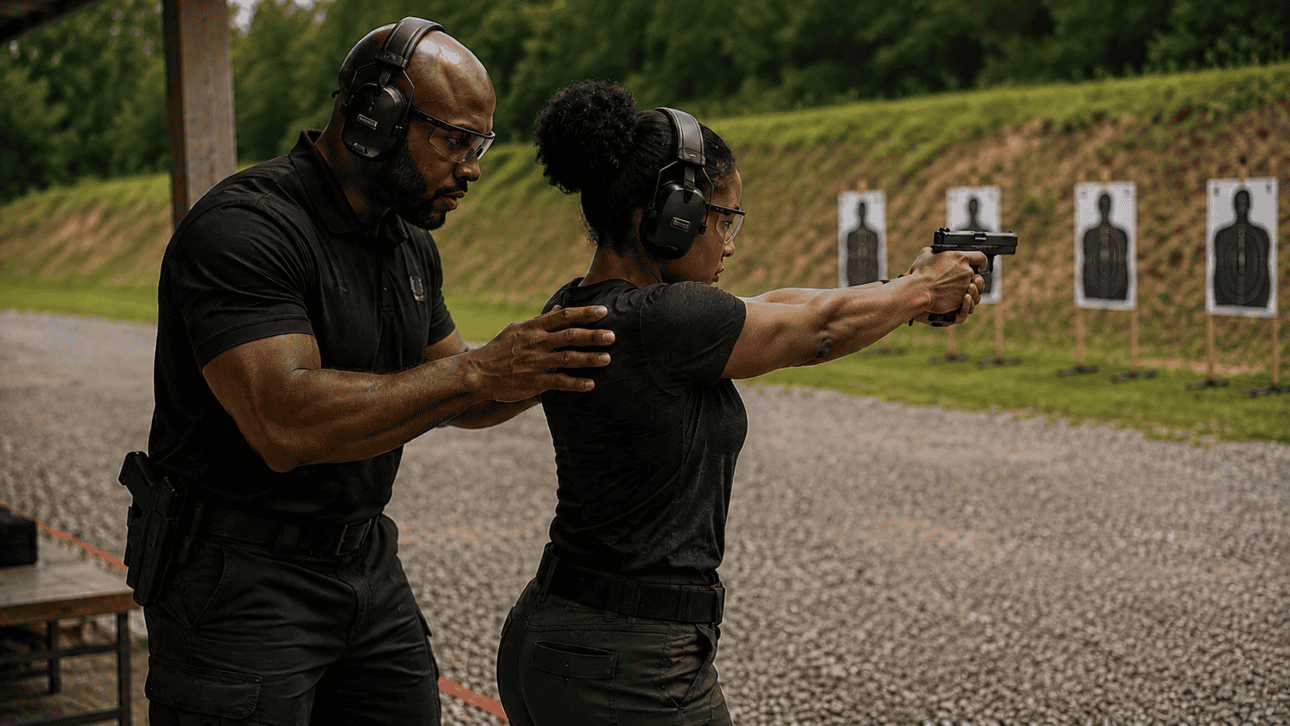
This is built around our Defensive Shooting Series. You will receive real-time, corrective feedback in 1 or more of the following areas:
- Trigger control
- Accuracy
- Sight alignment
- Dominant eye evaluation
- Recoil management
- Confidence building
Events Calendar
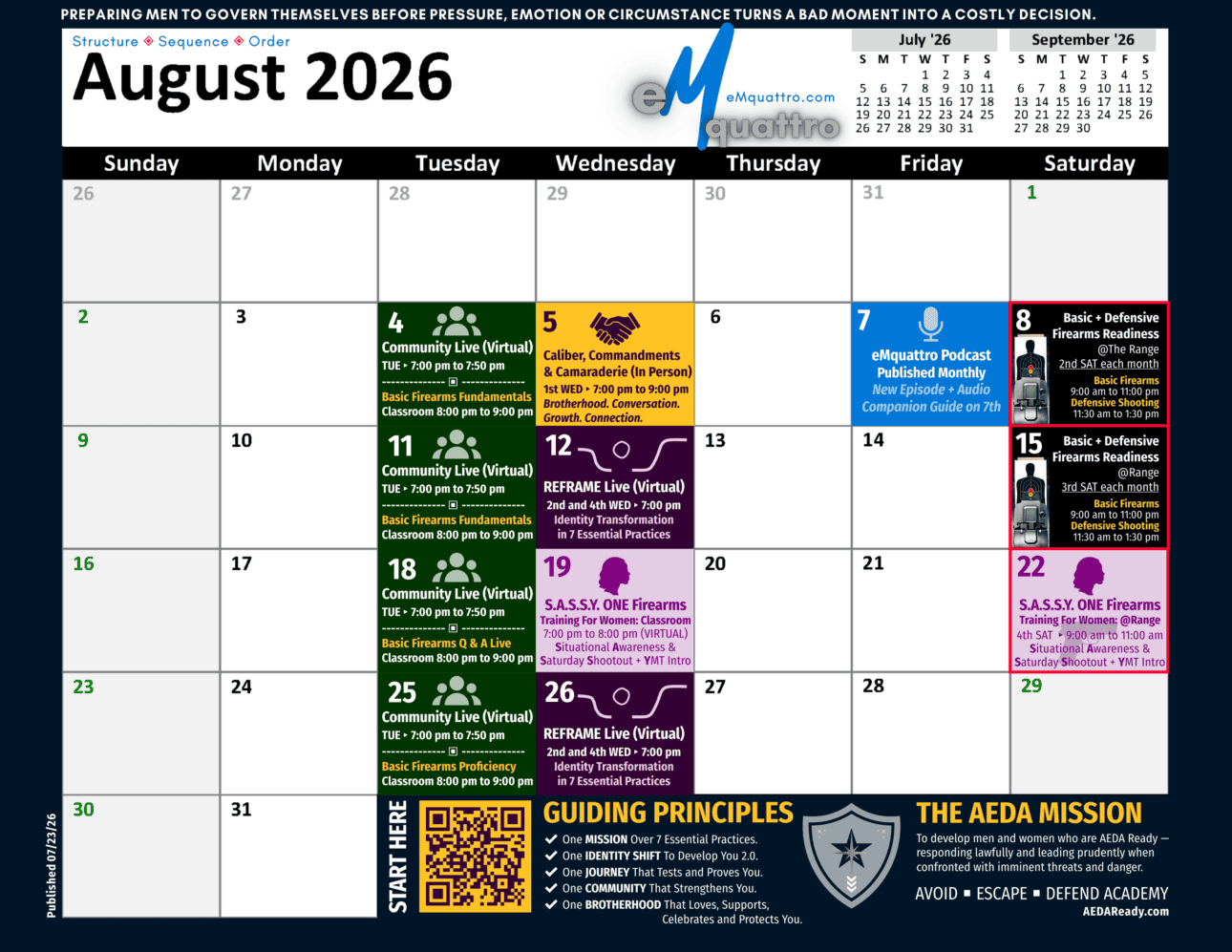
The calendar below provides you an overview of how we structure and sequence each month for your Development, Transformation and Readiness. A link appears below the image for this month’s Core Events.
Monthly Training Structure
Range Details and Firearms Guidelines
Everything you need to know before Range Live Fire — from what to expect as a new student to how to prepare for your training experience.
What If I’ve Never Handled a Firearm Before?
That’s completely acceptable.
You do not need previous firearms experience to begin developing safe and responsible firearm skills.
In fact, beginning without previous experience gives us an opportunity to help you establish safe, deliberate habits from your very first interaction with a firearm.
At AEDA, we don’t expect you to arrive Proficient.
We expect you to arrive ready to learn.
Your instruction begins with the fundamentals appropriate to your current level, which may include:
- understanding the universal firearm safety rules,
- becoming familiar with the basic parts and operation of a firearm,
- learning safe loading, unloading and handling procedures,
- developing a stable grip and shooting position,
- understanding sight alignment and trigger control,
- and learning what to expect before participating in live-fire exercises.
You will not be rushed simply because another student has more experience.
Our responsibility is to help you understand what you’re doing, why you’re doing it and what safe performance looks like before asking you to increase difficulty.
Your First Goal Isn’t Speed. It’s Control.
New students sometimes believe they need to prove themselves by shooting quickly or trying to keep pace with more experienced shooters.
You don’t.
- Your first responsibility is to become safe and deliberate.
- Then we develop consistency.
- Then proficiency.
- Then, when appropriate, additional speed and complexity can be introduced.
That’s part of the training progression:
Learn → Practice → Validate → Advance.
And There Is No Such Thing As a “Stupid” Safety Question
If you are uncertain about something involving a firearm, ask before acting.
We would rather answer a question you think is basic than have you guess while handling a firearm.
A responsible firearms student isn’t the person who pretends to know.
It’s the person willing to learn before acting.
So if you’ve never handled a firearm before, you haven’t arrived too early.
You’ve arrived at the beginning.
And that’s exactly where quality training should start.
Will This Training Adequately Prepare Me?
Yes — but no single firearms class can completely prepare you for every situation you may encounter.
Quality training should give you the knowledge, skills and foundation to continue becoming more capable and prepared over time.
Think of defensive firearms training as a three-stage progression.
- You first learn to safely and consistently control the firearm.
- Then you learn to maintain that control while movement, speed and changing conditions are introduced.
- Eventually, advanced training tests whether you can think, decide and perform safely under realistic pressure.
We describe these stages as:
- Level 1: Marksmanship Validation — Build The Foundation
- Level 2: Dynamic Movement — Add Movement, Speed and Complexity
- Level 3: Dynamic Scenarios — Add Pressure and Decision-Making
Level 1: Marksmanship Validation — Build The Foundation
This is where your development begins.
Before adding speed, movement or pressure, you need to demonstrate that you can safely handle the firearm and consistently perform the fundamentals.
Technical skills may include:
- Firearms Safety: Consistently applying universal firearm safety rules.
- Grip, Stance and Sight Alignment: Building a stable shooting platform and understanding how to properly align the firearm with the intended target.
- Trigger Control: Learning to press the trigger without unnecessarily disturbing the firearm.
- Weapons Manipulation: Developing safe, repeatable procedures for loading, unloading, reloading and addressing common malfunctions.
- Marksmanship Validation: Demonstrating consistent accuracy on a stationary target at appropriate distances before increasing difficulty.
In practical terms: Can you safely operate your firearm and consistently place accurate shots where you intend them to go?
That’s the foundation.
Level 2: Dynamic Movement — Add Movement, Speed and Complexity
Once the fundamentals become more consistent, training can become more dynamic.
Now you’re learning whether those skills remain available when you move, the environment changes, or your attention must shift.
Training at this level may introduce:
- Shooting While Moving: Maintaining safe firearm control and acceptable accuracy while changing position.
- Target Transitions: Safely shifting attention between multiple designated targets.
- Use of Cover: Understanding how available objects and positions may reduce unnecessary exposure.
- Time and Performance Standards: Introducing measurable time and accuracy requirements to evaluate performance under increased demand.
In practical terms: Can you maintain safe, effective firearm control when you’re no longer standing comfortably in one place with unlimited time?
This is where mechanical skill begins meeting environmental complexity.
Level 3: Dynamic Scenarios — Add Pressure and Decision-Making
This is where firearms training becomes much more than simply hitting a target.
Advanced scenario-based training can introduce uncertainty, competing information, time pressure and difficult decisions.
Depending on the training environment and instructor qualifications, this may include:
- Scenario-Based Training: Working through realistic situations designed to test observation, communication, judgment and decision-making.
- Force-on-Force Training: Using appropriate simulation equipment and controlled environments to experience interaction with other thinking participants.
- Stress Inoculation: Gradually introducing controlled pressure so students can observe how stress affects their thinking and performance.
- Decision-Making / OODA Loop: Learning to Observe, Orient, Decide and Act while identifying what is happening before choosing a response.
- Use-of-Force Judgment: Recognizing that having the physical ability to use a firearm does not automatically mean using it is necessary, prudent or legally justified.
In practical terms: Can you recognize what is happening, make an appropriate decision and safely use—or choose not to use—your capability under pressure?
That is a very different standard from simply shooting accurately.
So, Will One Class Make Me Ready?
No—and we don’t believe a responsible instructor should tell you that it will.
One quality class can make you more prepared than you were before you arrived.
But readiness is developed progressively:
- First, establish the fundamentals.
- Then, validate them.
- Next, add movement and complexity.
- Eventually, test judgment and performance under controlled pressure.
And throughout the entire process:
Train. Review. Correct. Repeat.
That’s why we don’t equate completing one class with becoming Prudent, Proficient and Protective with a firearm.
Readiness requires quality instruction plus an ongoing development plan.
At AEDA, our goal isn’t simply to help you complete a class.
Our goal is to help you understand where you are today, what your next level of development requires, and how to continue becoming READY.
That larger development philosophy is why AEDA Tactical Readiness operates alongside Ongoing Personal Development and Identity Transformation through our community partner, eMquattro.
How Many Students Are In A Course?
Class size depends on the type of training.
Our goal isn’t to put as many students as possible into a class. We intentionally manage class size so students can receive the observation, feedback and correction necessary to develop safely and effectively.
Range / Live-Fire Training
Live-fire courses are limited to a maximum of 12 students per instructor, with no more than 4 students on the firing line at one time.
While one group is receiving live-fire instruction, firearms not actively being used remain clear and holstered according to the course’s safety procedures.
Smaller firing-line groups allow the instructor to more closely observe each student’s:
- safe firearm handling,
- application of fundamentals,
- accuracy and consistency,
- and opportunities for immediate correction.
The objective isn’t simply getting rounds downrange. It’s making each repetition useful.
Virtual Training
Virtual courses are not subject to the same student limits because firearms are not being handled on a live firing line.
Class size may vary depending on the course format, but the objective remains the same: create an environment where students can ask questions, participate and understand how the material applies to them.
Coaching / Facilitated Training
For coaching and highly personalized instruction, one student or a couple is typically most effective.
This allows the session to be tailored to the student’s current ability, questions, objectives and specific development needs.
Small-group coaching may also be available for groups of five or fewer when participants share a common objective — for example, members of an organization’s security team.
Why We Manage Class Size
At AEDA, we distinguish between simply receiving information and receiving instruction that develops capability.
Information can be delivered to almost any size audience.
Development requires someone to observe what you’re doing, identify what needs correction and help you improve it.
That’s why our class sizes reflect the kind of learning taking place.
You aren’t simply purchasing a seat in a class.
You’re creating an opportunity to become more capable than you were when you arrived.
Where is Range Live Fire Conducted?
Training is conducted at selected ranges throughout the Birmingham, Alabama area.
Specific locations are provided after registration.
Do I Need My Own Firearm?
No.
Rental firearms are available when appropriate.
Rental Fee: $40 (includes 1 box of Ammo – 50 Rounds)
If you bring your own firearm and ammunition, you must abide by the facility rules on our caliber and ammo limits (see next section). You must also complete the firearm safety check with the Range Safety Officer.
If you’re unsure of which firearm to purchase, Schedule a Tactical Readiness Coaching Session and we’ll help you find the right firearm for you.
What Additional Supplies Are Required For Range Live Fire?
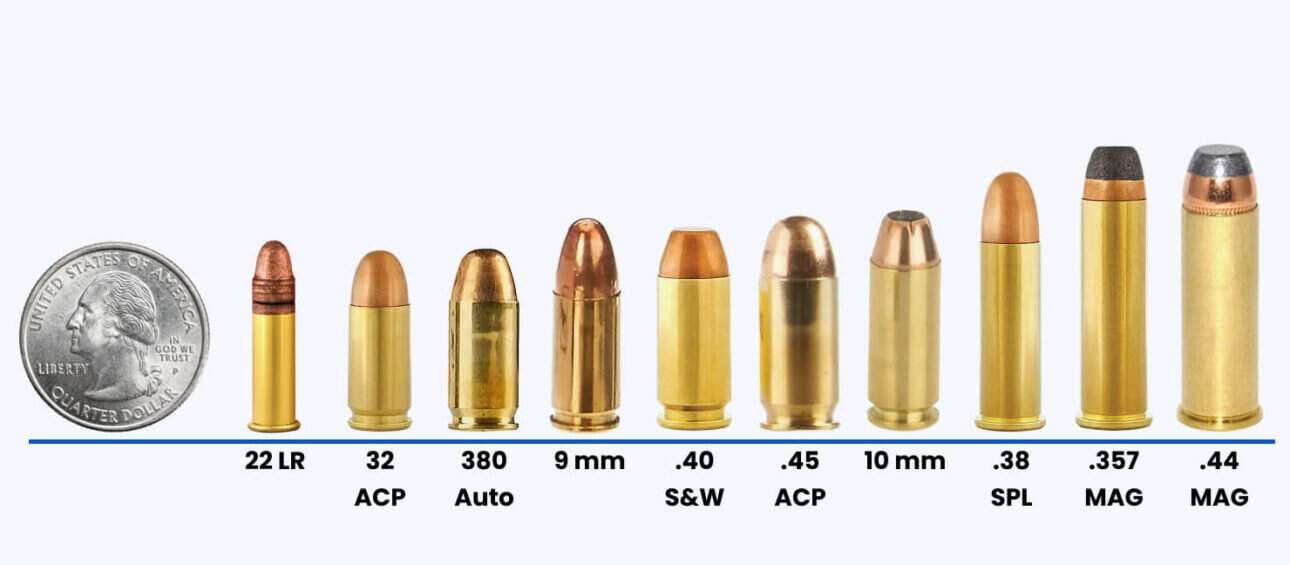
AMMO For [Handguns ONLY] in one of the following calibers:
- 9mm
- .40 S&W
- .45 ACP
- .38 Special
- .357 Magnum
- .380 ACP
- .22 LR
- NO RIFLES or extremely loud handguns
- At Least 1 Box of 50 Rounds (Training Ammo)
- Academy Link: Handgun Calibers
Eye and Ear Protection
- Eye protection (Link For Visual)
- Hearing protection (Link For Visual)
Laws, Rules and Regulations To Keep Everyone Safe
Safety for everyone is the essential factor.
Universal Firearms Safety Rules
- Treat all guns as if they are always loaded.
- Never let the muzzle point at anything you are not willing to destroy.
- Keep your finger off the trigger until your sights are on target and you have made the decision to shoot.
- Be sure of your target and what is behind it.
Waivers, Permits and Proof of Age
Before handling firearms, students must complete:
- Signed liability waiver – A firearms training liability waiver form is a legal document that releases instructors or training organizations from liability for injuries or damages that may occur during firearms training.
- Valid pistol permit (though not a requirement per Alabama laws). In Alabama, a pistol permit (also called a concealed handgun permit) is a legal document issued by the county sheriff that validates your right to carry a loaded pistol concealed on your person or in a vehicle under state law.
- Proof of age (at least 19 per Alabama laws)
Pre-Requisite Training and Range Fee
- Complete the Foundation Training (10 Self-Guided Firearms Safety Guidelines)
- Complete the Virtual Training – M-Tact Basic Firearms or S.A.S.S.Y. One
- Pay the Range Fee: $35 (at most ranges)
Alabama State-Level Firearms Regulations
STATE CONSTITUTIONAL PROVISION — Article 1, Section 26
- (a) Every citizen has a fundamental right to bear arms in defense of himself or herself and the state. Any restriction on this right shall be subject to strict scrutiny.
- (b) No citizen shall be compelled by any international treaty or international law to take an action that prohibits, limits, or otherwise interferes with his or her fundamental right to keep and bear arms in defense of himself or herself and the state, if such treaty or law, or its adoption, violates the United States Constitution.
- (Amended by Act 2013-267, ratified December 1, 2014, as Amendment 888.)
Age Requirements
Alabama law generally prohibits selling, giving or lending a pistol to any person under age 18. Ala. Code § 13A-11-57
Alabama also generally prohibits a person from delivering a pistol to a person if he or she has reasonable cause to believe the transferee is under the age of 18. Ala. Code § 13A-11-76
Alabama also prohibits individuals under age 18 from possessing pistols. Ala. Code § 13A-11-72(b)
Ammunition Purchases
Alabama does not require background checks for ammunition purchases, require ammunition dealers to be licensed by the state, or require dealers to keep records of ammunition transactions.
The possession or sale of brass or steel teflon-coated handgun ammunition is illegal, with the exception of teflon-coated lead or brass ammunition “designed to expand upon contact.” The possession or sale of “any ammunition of like kind designed to penetrate bullet-proof vests” is also illegal. The law exempts state and local law enforcement. Ala. Code Ann. § 13A-11-60
Possession Standards
Alabama generally prohibits persons with certain criminal convictions, persons subject to specified protection orders, persons illegally or unlawfully present in the United States, or those of “unsound mind” from owning, possessing or having control of a firearm. Please note that the state law on prohibited persons changes as of October 1, 2025 (see below).
Alabama law at Ala. Code. Ann. § 13A-11-72 prohibits the following persons from owning, possessing, or having under their control, a firearm:
- anyone convicted (in Alabama or elsewhere) of committing or attempting to commit a crime of violence as defined in Section 13A-11-70, a misdemeanor offense of domestic violence, or a violent offense listed in Section 12-25-32(15). A “misdemeanor offense of domestic violence” is one that that has, as its elements, the use or attempted use of physical force or the threatened use of a dangerous instrument or deadly weapon, and the victim is a current or former spouse, parent, child, person with whom the defendant has a child in common, or a present or former household member. A “violent offense” under Ala. Code § 12-25-32(15) means any of the 50 listed crimes or any substantially similar offense committed under any state or federal law.
- Anyone who is subject to a valid protection order for domestic abuse, as defined in that section.
- Anyone of “unsound mind” as defined in that section (generally, this means anyone involuntarily committed for inpatient treatment, or who has been formally adjudicated as mentally ill or incompetent).
- Anyone illegally or unlawfully in the United States or who has been admitted to the United States under a nonimmigrant visa that doesn’t fall into the exceptions in federal law at 18 U.S.C. § 922(y)(2).
State law has a handgun-specific prohibition: anyone who is a “drug addict or a habitual drunkard” is prohibited from owning, possessing or having control of a pistol; Ala. Code Ann. § 13A-11-72(b).
Minors are prohibited from owning or possessing handguns unless one of the exceptions in Ala. Code § 13A-11-72(f) or (g) applies. (General state law defines the age of majority as 19; see Ala. Code Ann. § 26-1-1).
Effective October 1, 2025, the new law on prohibited persons makes it a felony to own or possess a firearm by a person who:
- has been convicted in Alabama or elsewhere of any kind of felony offense within the previous five years or convicted of three or more felony offenses of any kind at any time (the felony convictions used to support a “three or more” prohibition must arise from a different indictment or complaint or otherwise arise on a different date of charge).
- has been convicted in Alabama or elsewhere of committing or attempting to commit a crime of violence as defined in Section 13A-11-70, misdemeanor offense of domestic violence as defined in Section 13A-11-72 (h), or a violent offense as defined in Section 12-25-32.
- is subject to a valid protection order for domestic abuse issued against them, as defined in as defined in Section 13A-11-72 (h).
- is of “unsound mind,” as defined in Section 13A-11-72 (h) (generally, this requires an involuntary commitment for inpatient treatment after a court hearing, or some similar adjudication that the person is mentally incompetent or insane).
- is illegally or unlawfully in the United States or has been admitted to the United States under a nonimmigrant visa that does not allow possession of firearms.
“Conviction” excludes any conviction that has been expunged, set aside, or for which the person has been pardoned or has had his or her civil rights, including firearm rights, restored.
A handgun-specific prohibition prohibits anyone who is a “habitual drunkard” or has a drug addiction from owning, possessing or having control of a pistol; Ala. Code Ann. § 13A-11-72(b)(1).
Minors are also prohibited from owning, possessing or having control of a pistol but the section contains exemptions at Section 13A-11-72 (f), most of which require the minor to have permission to possess a pistol from a parent or legal guardian who is not prohibited from possessing a firearm under state or federal law. (General state law defines the age of majority as 19; see Ala. Code Ann. § 26-1-1.)
Licensing of Possession / Acquisition
No state permit is required to possess a rifle, shotgun, or handgun. No state permit is required to purchase a rifle, shotgun, or handgun.
A person in possession of a valid concealed carry permit issued by Alabama is exempt from a federal NICS check when purchasing a firearm; see ATF Brady Chart (2025) at Brady Permit Chart | Bureau of Alcohol, Tobacco, Firearms and Explosives.
Guiding Principle
Prepare before it matters.
Where can I continue my development between training sessions?
Visit the eMquattro Community.
There you’ll find learning resources, Community Live, implementation tools and ongoing development.
Visit: eMquattro.com